)
)
)
Clayton Huber, Texas A&M Semiconductor Institute: On the motivated and dependable military talent pipeline
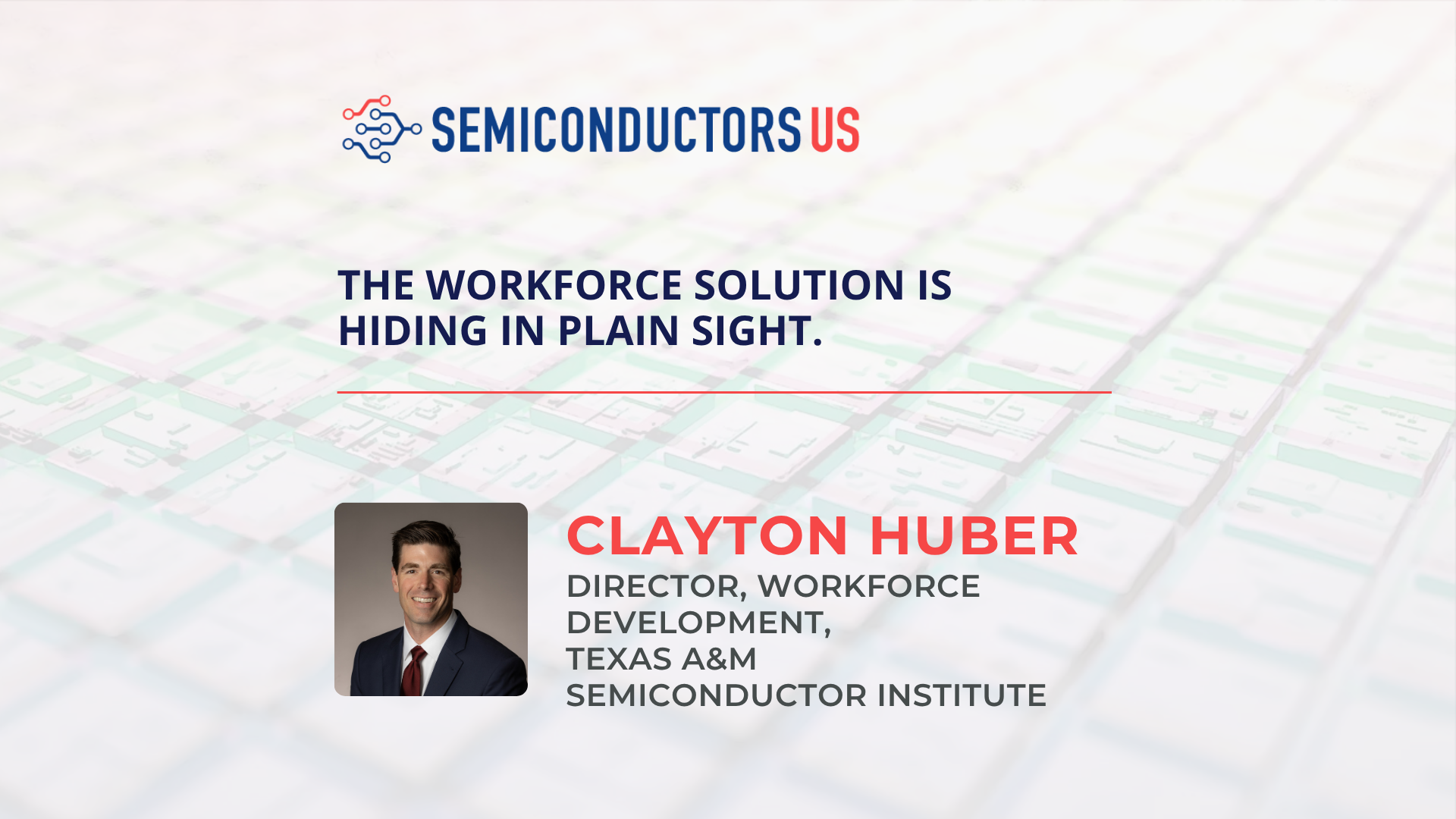
Ahead of his speaking appearance at Microelectronics US, in Austin, Texas on April 22-23, Clayton Huber, director, workforce development at Texas A&M Semiconductor Institute, discusses the viability of the military talent pipeline for advanced manufacturing, how it can be achieved, as well as best practices for industry and academia collaboration.
---
Hi, Clayton. Tell us a little bit about you and your career to date. Who is your mentor (if any) and what is the biggest lesson you have learned during your career?
I made a faith-based decision to dedicate my professional abilities to educating and employing people for their good and also for the benefit of our economy and security. Prior to my role in workforce development at the Texas A&M Semiconductor Institute, I served for 20 years in the U.S. Navy. I started as a nuclear technician on a submarine and finished my career as a helicopter pilot.
I learned a lot of lessons in my previous career, many of them the hard way, but one practical lesson that stuck with me and served me well is this: always refer to the source documents—the foundational knowledge, policies, and procedures of the profession.
Your remit includes creating viable pathways from a variety of areas - including the military talent pipeline. How important is that workforce in this context and what are the key transferable skills that they have for advanced manufacturing industry in your opinion?
In Texas alone, the military talent pipeline includes over 22,000 service members who separate from service every year. The former service members and their families are an enormous source of talent with tangible technical skills, eligibility for security-sensitive positions, and the critical professional and relational skills that employers demand. These are motivated individuals who can be depended upon to do hard things reliably, and if you take care of them during their transition out of service, they will take good care of your production, your tools, and your company.
Jay Koranda of Korn Ferry recently wrote that 'many servicemembers assume the industry is about designing or repairing computer chips. In reality, most critical roles center on operating, maintaining, and troubleshooting highly automated, multi-million-dollar robotic systems working at nanoscale tolerances.
‘For organizations navigating fab ramps, equipment installs, and multi-site expansion, transitioning military can represent a predictable, renewable technical talent pipeline — when approached intentionally.' How do you assess these remarks, and do you agree with them?
Before answering this question, I had to reach out to Jay and connect because I think everything he said is spot-on.
If we can clearly explain what technicians, technologists, and field service engineers actually do in semiconductor fabrication and advanced manufacturing—and if we highlight the working hours, conditions, pay, benefits, industry growth (and the job security that comes with it), plus the pathways for advancement—then I agree: we will have a strong, steady pipeline for separating servicemembers. Done well, this approach can help close the growing employment gap in semiconductors.
With combined efforts of federal and state government, regional higher education, and employers, existing programs like SkillBridge, Registered Apprenticeship Programs, and VA education and training benefits can come together to make this a smooth and predictable transition for servicemembers and a favored employment source for the semiconductor industry.
What interesting initiatives and projects are you working on right now that you can tell us about?
Right now, the Texas A&M Semiconductor Institute (TSI) is developing several workforce initiatives to strengthen the Texas semiconductor talent pipeline. We’re building rapid, hands‑on training programs in vacuum systems, plasma fundamentals, fab safety, cleanroom procedures, and metrology to meet urgent technician and engineer needs. We’re also developing a statewide competency framework by analyzing industry job requirements and aligning them with programs across universities and colleges. At the same time, we’re collaborating with industry and convening representatives across academia to grow these efforts and connect more students directly to semiconductor careers.
Our vision at TSI is to become a collaborative semiconductor environment where applied research becomes industry reality, high-tech labs enrich promising startups, and individuals train for high-need, high-paying jobs — all contributing to long-term economic growth and supporting national security.
What are the best ways in which industry and academia can collaborate in ensuring the semiconductor talent pipeline is maximizing its potential in your view? Are there any other gaps in the industry that you see right now?
Industry and academia work best together when they co‑design solutions, not just exchange information. The most effective partnerships I’m seeing involve companies giving us real‑time visibility into their workforce needs—specific KSAs, job requirements, and skill gaps—while we build training, certificates, and pathways that map directly to those needs. When employers offer support through tools, equipment, scholarships, subject‑matter experts, and internship or apprenticeship slots, and universities respond with rapid, hands‑on programs, everybody wins.
How do you assess the impact that AI is currently having in the space - and how prepared are both industry and academia for it?
AI is transforming chip design and manufacturing by boosting productivity and lowering the skill threshold for many complex tasks. Research from Stanford’s AI Index and McKinsey shows AI-assisted workers—regardless of experience—produce faster, comparable‑quality technical work. Industry is adapting quickly, academia is still catching up, and leaders will be the ones embedding AI into engineering and technician training now. That’s exactly what Texas A&M is doing through AI‑enabled design, validation, verification, and hardware security programs that prepare the workforce for where the industry is going.
What message will you be looking to get across at Microelectronics US and what do you hope the audience will take away from your session?
Come to Texas and put down roots in our state. You can build your business and grow your own talent by supporting the K12 to PhD pipelines that Texas higher education alliances are working hard to build.
How important in your opinion is not only having an event like Microelectronics US bringing different stakeholders together, but also holding it in Texas where the semiconductor industry is so vital?
Holding it in Texas magnifies the event’s impact. Texas is one of the most business‑friendly states in the nation, with a regulatory environment, tax structure, and economic development strategy that consistently makes it the top destination for semiconductor investment. When industry gathers here, they’re meeting in the heart of a state that is already leading the U.S. in advanced manufacturing growth.
It also showcases the state's unmatched higher‑education capacity and talent sources, especially that of The Texas A&M University System, which is mobilizing research, training, and workforce programs at a scale the industry simply can’t find anywhere else.