)
)
)
On laser-diamond interaction for UWBG semiconductors – and getting talent together
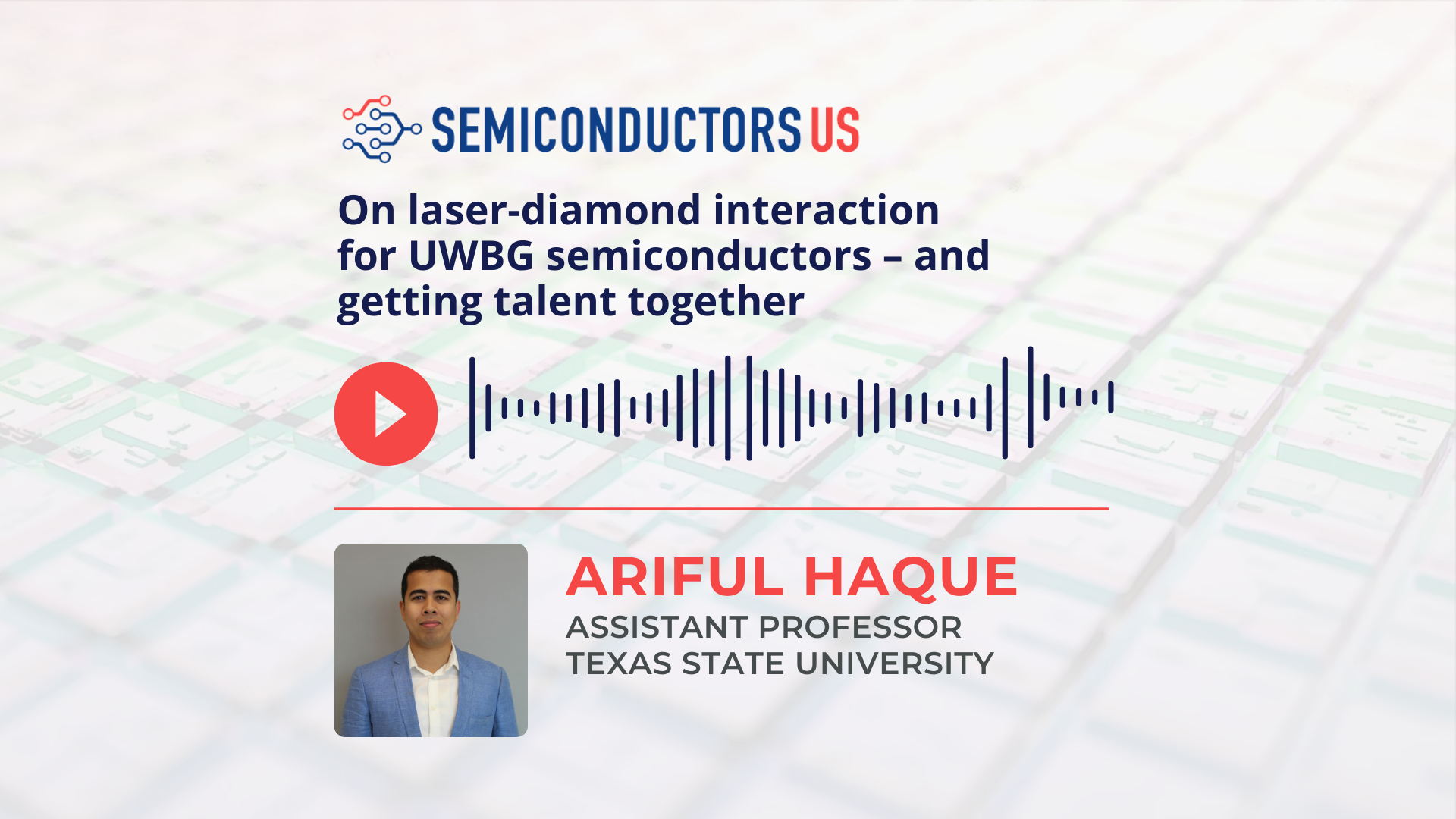
Wide- and ultrawide-bandgap (UWBG) semiconductors are an extremely exciting development for the semiconductor device community and wider industry. Yet it is not entirely without its hitches. Any research paper will tell you that, while the ‘exceptional’ material characteristics can enable more robust and efficient devices, there are question marks over problem areas such as thermal management and doping.
Attempting to solve these problems is Dr. Ariful Haque, assistant professor of electrical engineering at Texas State University (TXState), and his cohort of researchers and students at the UWBG Semiconductor Lab. Having ‘always wanted to become a researcher and university professor’, he took the role at TXState after a stint at Intel.
Watch the full interview with Dr. Ariful Haque below.
At the lab, diamond, iii-nitrates and gallium oxide are fabricated. The drawback of gallium oxide, Haque explains, is through inefficient heat extraction. Diamond, with the highest thermal conductivity of any material, is a better bet than graphene to solve it. “People claim on graphene, the thermal conductivity is very large, but that is only on its plane, on its sheet,” explains Haque. “Across the plane, the thermal conductivity is very poor for graphene so, here, diamond [has] got the edge.”
Diamond, however, is hard to produce and hard to control, and has a habit of converting into graphite. Yet Haque notes a ‘major milestone’ in trying to solve this in what is called laser-diamond interaction, for which a patent has been filed.
“If you implement any process technology, a little bit [of] harsh process technology, diamond tends to convert into graphite, and that’s a big no-no in microelectronic manufacturing,” explains Haque. “We have incorporated a new technique – we call it laser-diamond interaction – and through this we were able to demonstrate that the graphitic content in diamond could be reduced or eliminated if we implement this technique.
“This is a major milestone that we have achieved in diamond electronics, because in the future, anyone producing any diamond-based devices… will obviously encounter the challenge of graphitisation in diamond, and to overcome this challenge, they will have to implement this process flow to eliminate the graphitic content in their diamond chips.”
Doping, where trace metal impurities are intentionally introduced into a material’s crystal lattice to modify electronic, optical, or structural properties, is also ‘very challenging’, Haque notes. It is challenging “for so many reasons, including incorporating a huge amount of dopants within a small zone,” adds Haque. “We are trying to develop new process strategies to create low resistance contacts to dope these kind of materials to improve the electronic and optical properties.”
Such innovation in research requires not only funding to make it happen, but for academia, industry, and policy to work together. In August, Texas State University received a $7.5 million award from the National Science Foundation to establish the CREST (Centers of Research Excellence in Science and Technology) Center for UWBG Semiconductor Device Materials. Haque notes that this funding will be used for training graduate students and postdocs in this discipline, as well as AI implementation in microelectronics. There was also a $1m Department of Defense grant awarded last year among others.
Haque feels that, more broadly, greater efforts can be achieved. “I feel… more attention should be paid towards bridging the gaps between industry and the universities,” he says. “I would love to see more dialogues take place between the industry leaders and the university leaders, since this is a national priority to keep up with current needs, not only from the AI perspective but also from the defense industry perspective.”
Investment dovetailed with implementing the right policy is key to ensure the US retains its edge, notes Haque. “That can only be done if we initiate a lot of dialogues, town halls among the leaders, and not only from industry, but also academia.
“We need a lot of talented people,” he adds. “A lot of talents are going towards many different fields… we need experts, talented people not only from electrical engineering, but also people from physics, people from chemistry, even people from other engineering disciplines like mechanical engineering [and] water resource engineering.”
At Microelectronics US, taking place in Austin, Texas on April 22-23, Haque, who sits on the advisory board, notes how important these dialogues will be for students of all stripes.
“Through this event, what I believe is that students will get out of their classrooms or university buildings and they will have an opportunity to interact with people from industry, national labs… higher level at the policy making level, from the national lab group leaders and division leaders,” he says. “They will have the opportunity to interact with those folks, one-on-one.
“And these kind of platforms, they will, in the years to come, remember all these discussions – if not all, maybe the important ones – while they’ll be taking decisions, which directions they will pursue to build their career.”
With many of Haque’s alumni already working in renowned companies or becoming assistant professors themselves, the UWBG Semiconductor Lab at Texas State appears a pretty good place to start. “It’s been a good journey so far,” concludes Haque. “I enjoy interacting with new people [who are] interested in contributing to this microelectronic world.”