)
)
)
Rachel Lipson: On sustaining the early CHIPS momentum and new frontiers
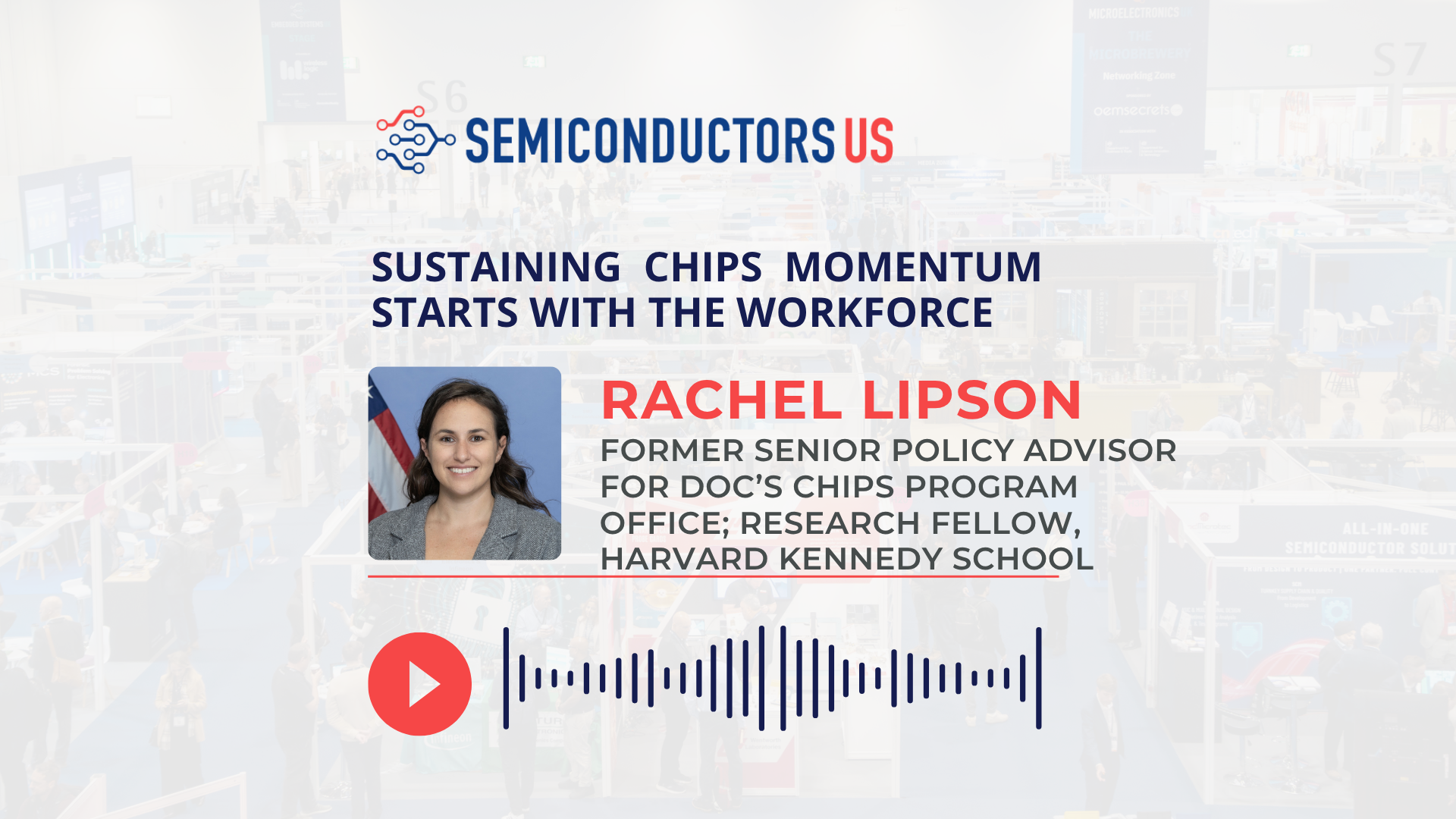
The CHIPS and Science Act remains the ‘cornerstone of US semiconductor resurgence’, according to industry group SEMI. Yet amid the success stories of the $53 billion investment, manufacturing new facilities is only one part of the job. Getting the workforce in place as the facilities come online – over 100 projects in 28 states, expecting to create and support more than 500,000 US jobs by 2032 at a half-a-trillion dollar private investment – is the other half.
Rachel Lipson, research fellow ved as a senior policy advisor at the CHIPS Program Office. She says she was ‘excited’ about some of the early results of the Act and ‘workforce being core to the strategy’, but also notes the challenges of such an ambitious initiative.
Lipson, who is speaking at Microelectronics US at Harvard Kennedy School and an expert on workforce strategy, ser
in Austin in April, notes that timing and coordination are hard. “You don’t want to overtrain before facilities are ready, but you also don’t want to miss the boat and have workforce become the bottleneck that might stand in the way of you getting your goals done,” she says.
Liaising with states, regions and localities is key; from a federal perspective, Lipson saw her office’s role in part as a chief organiser. “One of our key comparative advantages as the federal government was to get the right incentives in place, so all the different players that matter for workforce development are at the table, and work together quickly to get our collective goals done,” she says.
Lipson praises the efforts of those on the ground, particularly in terms of where things are scaling up. “[I’ve] had the privilege of being in Austin a number of times and seeing the amazing work that’s being done on the educational side of all this to help very quickly expand the technician output, for instance, for Samsung’s expansion,” she notes.
Listen to the full interview with Rachel Lipson
“States and regions are doing great work, and the federal role is to make sure they have the resources to support them as they accelerate those efforts, and help scale things that are working nationally.”
One important aspect of scalability is ensuring all the pillars move up equally and that nothing gets siloed. This may be counterintuitive on first glance given the CHIPS Act’s singular focus on semiconductor. Yet, as Lipson explains, if you’ve trained people up and there’s a downturn and nowhere for them to go, it not only affects the present, but also the future – because why would the next class of students go into that industry?
Lipson notes that in Arizona, where TSMC is building, there are plenty of hiring needs in semiconductor, but also in batteries and data centers. “I think it’s really important right now… [that] on the technical piece of all of this, there’s a good focus on ensuring there’s a transferable foundation for some of these high-tech production industries,” she says.
Industry can play in important role here in 'not just only wanting the shiny penny that's exactly for them', Lipson adds, but also creating that 'common shared foundational core' that makes someone 'well-prepared to jump into the semiconductor industry when they get that customised add-on.'
"I do think for the US, this is some of where we need to be going," adds Lipson. "Thinking across a number of these growing technology fields - how do we build a bigger base and get more people into those? And then, what additional education and training do you need to add on to help you thrive in an industry like semiconductors?"
Lipson’s current research also has relevance for the semiconductor industry. The premise of the New American Frontier project is on a new wave of technical jobs, many of which do not require a four-year degree, and exploring the things that US ‘frontier regions’ – places that have traditionally been early to different technologies – have done right.
Alongside semiconductors, the project spans areas from data centres, to advanced nuclear energy technologies and batteries among others. It all reiterates how the key is bringing all these areas together. Lipson notes that her panel session at Microelectronics US will hopefully feature some of the research insights from the semiconductor space.
“My hypothesis is that, contrary to what some may think, there can be significant new jobs created linked to frontier technology industries,” says Lipson. “A good share of those jobs could be accessible without a four-year degree, but it’s going to require a different set of policy choices in the US about how we do education, and how we think about getting people into those roles.”
Alongside implications from her current research to semiconductors, Lipson will look to provide a positive overall message at Microelectronics US.
“I hope I can be helpful in emphasising that we have made real progress in the US building out the workforce for microelectronics,” says Lipson. “This is a long-term play. It’s not something that can be done in one year, or even one administration.
“That means we’re going to need a long-term commitment that’s going to require everyone working together on this; not just the government, but also the private sector and educational institutions, to sustain the momentum of what’s been built,” Lipson adds
“I do think it’s possible, and achievable, that the US is going to have the world’s most competitive, skilled, talented semiconductor workforce. But it’s going to require a commitment to not losing attention, keeping an eye on the ball, and sustaining some of the early momentum that we’ve seen since the CHIPS Act was passed.”