)
)
)
Rana Faryad Ali, MIT: Why scalability, reliability and integration are key for advanced materials
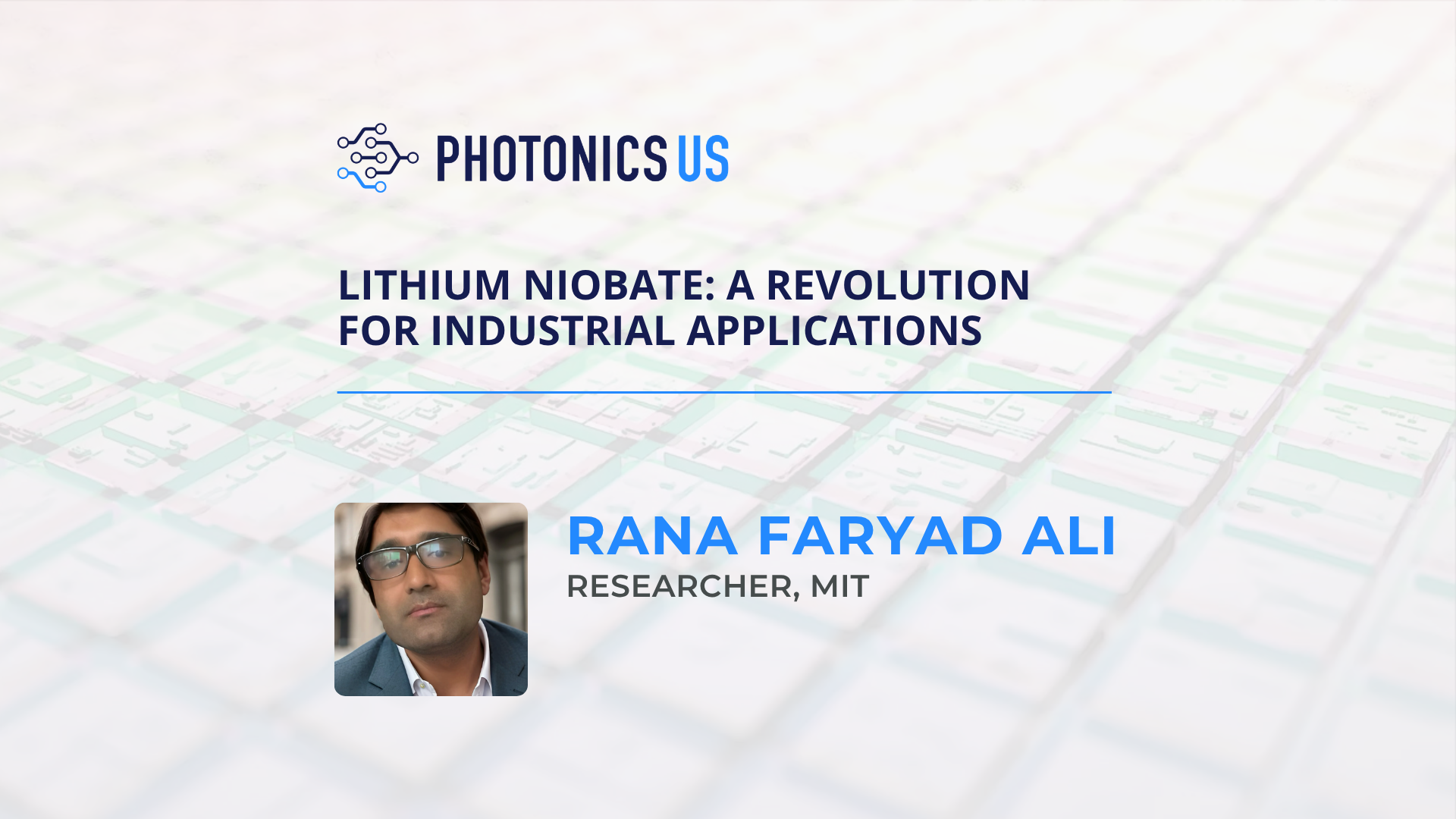
Innovation in advanced materials will continue to flourish – but in order to take the technology from lab to market, there needs to be a stronger focus on three areas, according to Dr. Rana Faryad Ali, researcher at MIT focusing on advanced materials for photonics and electronics.
“In academic labs, we’re very focused on enhancing the performance of devices, but we are not focusing on the scalability issues, reliability issues, and integration of those devices with different platforms,” he explains. “If we can achieve these three steps together, no matter [if] our device is performing only at 70% benchmark scale as compared to lab, but still, we will be able to achieve quite a success.
“If we can address the three major challenges, then we will be able to take our technology from lab to the market.”
Ali, who describes himself as a ‘photonic guy’ at heart, views the landscape from a particularly interesting vantage point, combining his academic research with a passion for commercializing technology and entrepreneurism. One such project is in designing advanced sensors for biomedical analysis for what he calls a ‘revolutionary step in the field of photonics, semiconductor and advanced materials’. The sensors are still in the process of being developed and optimized, but watch this space.
He notes that in order to commercialize any technology, three stakeholders need to be aligned; academia, making the discoveries; industry, wanting to find the right patents; and sponsors, to help academia and industry function at the right benchmark scale.
“These three stakeholders… I think should align their goals,” says Ali. “What are the current needs? How can we invest in those needs, both in industry and academia? Then we can design some technologies which this world really needs, and then we can commercialize from lab to market.”
From the research side, one material in which Ali is particularly invested is lithium niobate. It is a key material in modern photonics, with its crystals a vital component across various linear and non-linear optical applications. “A few years ago, it was very difficult to design single crystalline lithium niobate material,” explains Ali, “but currently you can see that this revolution is coming for industrial applications where thin film, lithium niobate devices are already being commercialised at mass scale.”
Cost in designing lithium niobate devices remains a prohibitive factor; however, Ali’s research is looking to solve this problem. A recent paper presents a technique for the ‘scalable patterning of lithium niobate at ambient conditions, eliminating the need for harsh etching conditions and cleanroom protocols.’
“You can design devices just fitting in a common lab space, but at mass manufacturing,” explains Ali. “We were able to pattern lithium niobate on a full-scale wafer just in a common lab setting. This is a huge discovery which we made not only by optimizing the material, but also by designing the right precursors and composition where we were able to achieve single crystalline lithium niobate at ambient condition.”
With one eye on the research breakthrough and another on the next big use case, Ali is exploring the potential of lithium niobate for greater optical communication, particularly in the data center. While he says he is still brainstorming the next industry he wants to impact, the focus will be on designing advanced photonics and semiconductor devices.
“I love to work with lithium niobate,” says Ali. “I think it’s the most revolutionary material which people are currently using for optical communication, as well as data transfer at very high rates.
“I want to hybrid these two sides – photonics and semiconductors – to make a platform which is more energy efficient, more cost-effective, and performing at a very effective level for optical communication and for data storage,” he adds.
Ali is speaking at Microelectronics US, in Austin on April 22-23, on materials, devices, and emerging system architectures of scalable integrated semiconductors. The overarching message will be around the three pillars of scalability, reliability and integration – but also noting cost.
“This will be a core message where people will not only learn about materials – they will also learn about the system level integration,” he explains. “They will also learn how to evaluate those devices to benchmark with the already existing devices – are they performing better or worse? And how can we control the cost of the device to make it profitable if we want to really commercialize? Because to sustain growth, we have to have cost-effective processes and devices.”
There is another core message which runs through when speaking to Ali. The need to scale up, to commercialize and go to market, is vital because, whether a biomedical, environmental, or optical communication use case among others, it has the wider benefit to humanity. It is this which ultimately fuels Ali’s passion.
“I think opportunities are everywhere,” he says of the industry landscape. “It depends on the passion of the person, what field you want to explore, but if you are working in photonics, it’s a semiconducting material; it’s everywhere.
“You can take this field to any direction – they’re all integrated towards each other. So, we should explore our passion where we can make most impact and in which field.”